I was surprised as well. In my case the plates contain around 100 µl of samples for qPCR. With our new adapters that ensure more precise placement we unfortunately experienced the described issues detecting liquid, but only in one plate type of two that we use. I am still unsure about all the factors that influence conductivity.
Carrier material is clearly one of them, further I think that the radius of the well and the shape of the bottom (smaller and V-bottom in the problematic plate) seem to play a role.
It’s quite nebulous and I will dig deeper, but for now I have a way to resolve my issues.
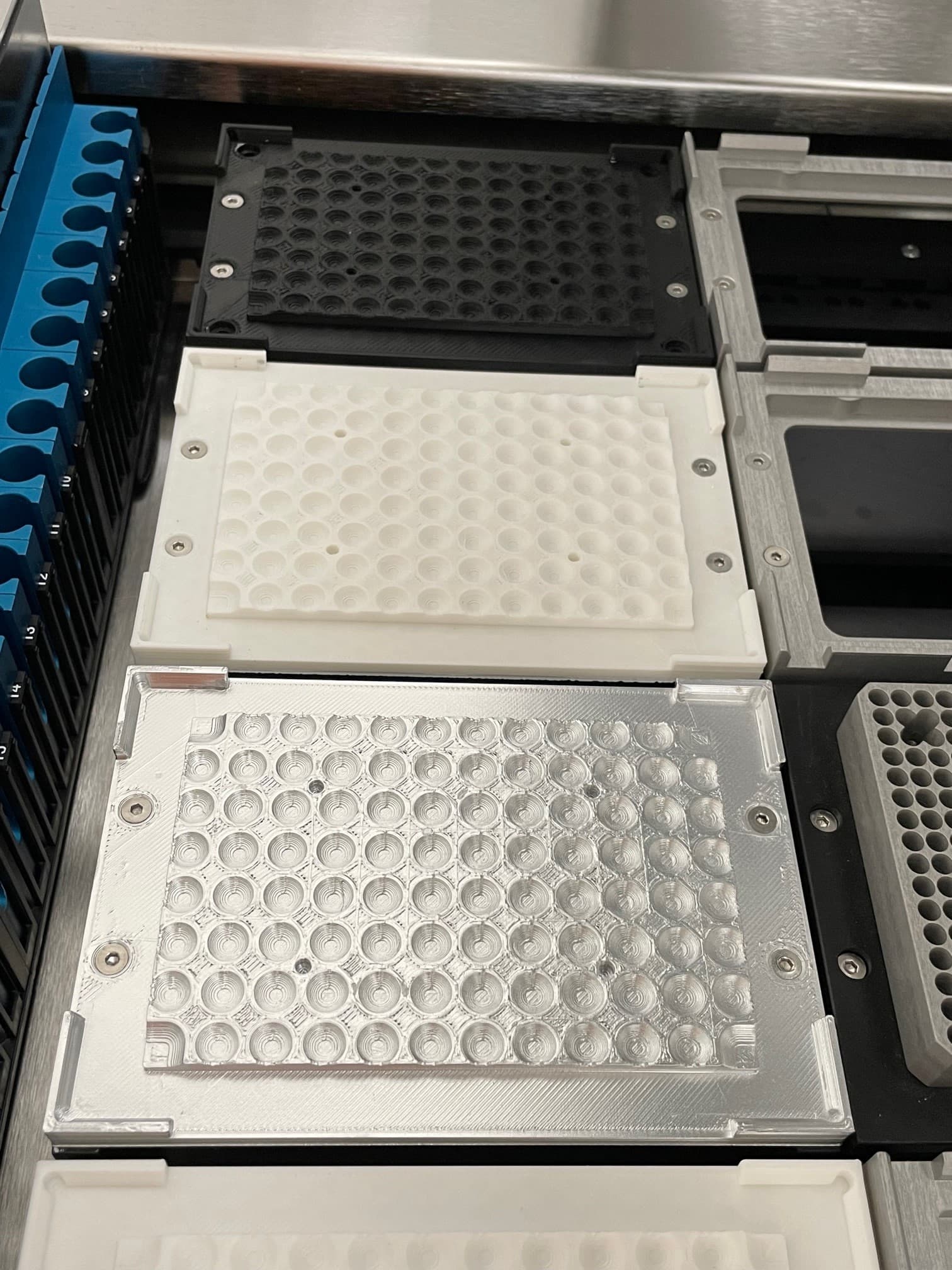
Today I compared 3 different adapters (conductive material, nonconductive and non-conductive painted with aluminium-spraypaint) with a range of volumes between 20 µl and 120 µl and “very high” as well as “high” cLLD sensitivity.
Turns out, that the conductive material is substantially better in that I successfully detected 8/8 40 µl wells at high and very high sensitivity whereas both other adapters fail at some of the same wells. The aluminium paint unfortunately has only minor advantage besides cool looks.
The plate I used is from PlateOne, a semi deep 500µl storage plate.
3 Likes
@Florian I’ve been going down the same rabbit holes the past couple of weeks. I would be curious to try your test method. Would you be willing to share it?
Hi @tbever sure, I have prepared the package file. You can of course adjust everything to your system and could e.g. also aspirate a certain volume from the source and discard it and then retest the liquid level. This done over a loop will give you a very nice curve of the actual volume and will thus circumvent any issues of the Star calculating it wrongly.
Unfortunately I don’t know if there’s a way to upload the files to the forum - thus I have used swisstransfer: SwissTransfer - Envoi sécurisé et gratuit de gros fichiers
Hi @florian. Thank you for sharing that. For some reason I am missing the “HSLDlgLib.hsl” library. Would you happen to know where I can find that?
Hi Thomas, because I have extracted this test method from a full PCR setup method, there are several libraries that are remnants from that but that aren’t used in this method. You can just remove said library, as it just includes additional dialog features.
Interesting! Where did you get the adaptors from?
We had them designed and 3D-printed for us according to our specifications. In the end an adapter is just a plate with a rim and 4 holes for screws.
Makes sense, thanks! I think I’ll need to find a UK company that can make the conductive metal adaptor for us… That’s not 3d printed is it?
Unrelated to the topic here but it looks like you have some 3d printed tube carriers there. Are these autoload-able? Would you be willing to share drawings/model files?
@Gareth The conductive filament seems to be just fine. No need to go more expensive. 3D printing metal, while possible, seems to be much more expensive than CNC aluminium. There are services for the latter from your standard STP-file, I have inquired prices from Get instant CNC machining, 3D printing & sheet metal fabrication quotes - Protolabs Network but haven’t ordered anything. I can hook you up to our 3D-Design person, if needed - he also does the conductive 3D printing. We are from Germany, so close by.
@acrith Actually, no, those aluminium inserts are available directly from Hamilton to be able to use 2 ml tubes (e.g., Eppendorf or Sarstedt) on the 32 position 1T tube carrier.
Ah, I see. Thanks for making that clarification. I’m hoping I can get it a try the next time I have access to the instrument.