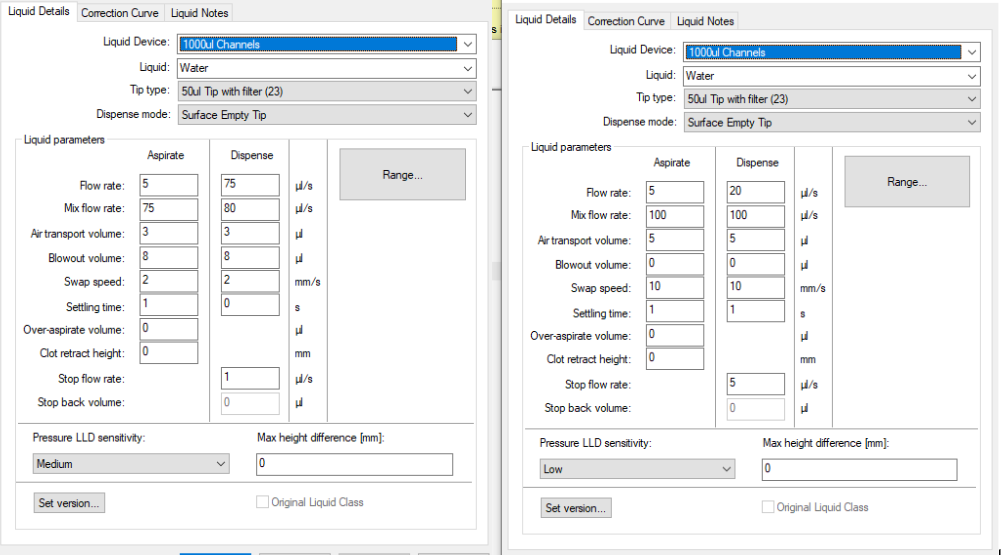
I am troubleshooting some cross contamination issues, and rediscovered that we have been using different liquid classes for the aspiration and dispense part of a particular step. I wonder what sort of issues this may have caused. e.g. Air transport is 3 on aspirate, 5 on dispense, and blow out volume is 8 on aspirate and 0 on dispense.
I notice that the pipetting arm does a weird pause after moving into position above the dispense location - so I am worried what might be happening with the different parameter settings here (there is a warning in the log file about the different liquid classes).
It depends on your liquids that you are transferring. I simply assume here there was a reason for two different liquidclasses and I assume the liquid is “water-y” of a nature.
The most common cause of contamination can be found in droplets or aerosols. Since your dispense speed is 20 µl/sec it doesn’t sound like it would eject the liquid with force into a well. The other factor that could contribute then is droplets. Again assuming you are aspirating water, the AT and blowout look fine for the liquid. On your dispense you do not have any blowout defined, but your AT is 2µL higher than your aspirate. Since the AT is aspirated last and dispensed first, it could cause some sort of aerosol and I expect this is the “pause” you observe during the movement. The plunger needs to “reposition” for the new settings.
Is there any reason for the different liquidclass? Have you tried with the same liquidclass for asp/disp?
@Pascal Thank you for your reply. It’s low concentration DNA in TE at the end step where its transfering the DNA out of the deep well plate with beads. It’s a double elution, 18ul then 18ul. So first transfer its into plate format empty matrix tubes (0.3ml) second elution into that tube with ~15ul. It is set to transfer 18ul - but some will have evaporated so there will be less than that. We dont use CLLD as it doesnt work at those volumes.
We have tried the same asp and dispense liquid classes - I don’t remember the specific reason they are different here, but probably out of desperation because we’ve been troubleshooting this contamination problem for a long time (we are in validation phase - the contamination is pretty sporadic - in a plate of 84 samples, half negative controls, if we run it 3 times the same way, we don’t see it every run - and when we do see it, its maybe 1 or 2 negative wells. So i assume its a random droplet?).
With the low volumes we are dispensing, since we can’t use CLLD, is it best to dispense just above the liquid, at the liquid level, just below? We observe that the tips have liquid on the outside of them after dispense and are worried this is the source of droplets. Due to this we dispense just above liquid level. But in general i see the advice is that its best just below.
Sounds to me link a regular liquidclass for elution buffer would suffice here. Even a water liquidclass (I always try to base my liquidclasses from the liquid that resembles the most, then do LVK to confirm or Absorbance measurements if the volume is low).
Contamination is contamination and you don’t want that in any NGS or other prep, so it should be solved. I luckily have the same kind of transfer, so my settings for the transfers
Aspirate with channels, use a fixed height (or touch-off, whatever you like) of 0,7mm from the bottom. (I use Nunc 2mL DWP). The liquidclass on the left (5 µL flowrate on aspirate) looks quite fine. I would not use such a large blowout, make it at 2 or 3 µL.
Dispense speed could be slower, but 75 is not absurdly high. Your stop flow rate (the speed at which the transfer is interupted is quite slow - which is great for water - ) but increase this to 5 or a bit more. Just to cut the transfer faster.
Dispense height in the Matrix tubes (which I am also using, but then 500 µL) is set to 0.7mm from the bottom (or touch off).
One thing I notice is that you transfer 18 µL to get 15 µL. I would also check your correction curve here. If you are aspirating more liquid than there is in the plate available (because your configured 18 is actually 21 in the curve) you might be aspirating air and that ejects out of it.
Simple experiment is possible with the Veriplate or any other absorbance based assay to determine the correction curve. >10 µL can be done with the LVK.
I can also share you my liquidclass, sent me a DM if you like.