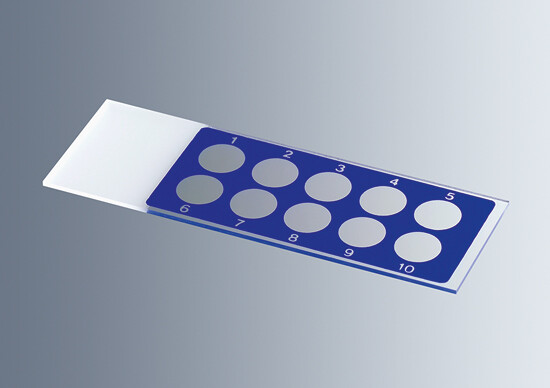
With a Hamilton STAR, I’d like to pipette ~ 3ul of a sample from a plate onto a microscopy slide to identify the cell types present. (The slides have defined wells like below)
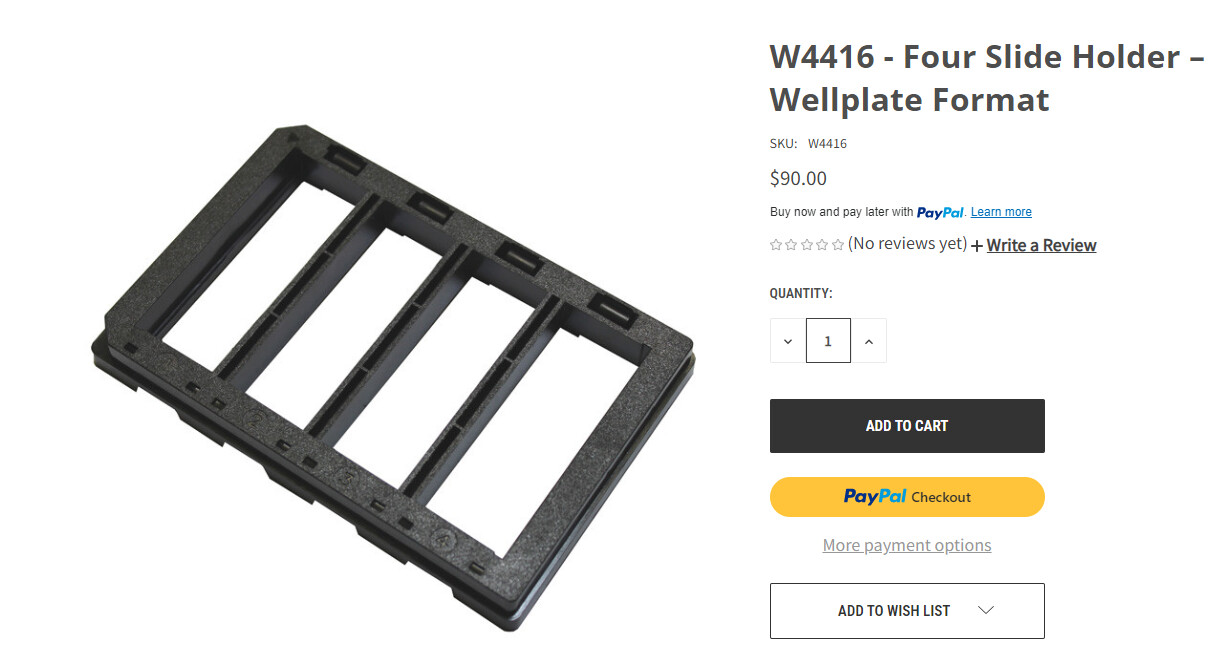
There appear to be SBS format slide holders (not sure if they work on hamilton carriers).
Theoretically, I think this is feasible, but i’ve not seen this set up.
I’ve never done something like this, but I believe it would be very feasible if you are willing to put in a bit of work.
Quickly check to see if the SBS format slide holder fits nicely onto a plate carrier position. If not you may have to 3D print something to make it compatible(or maybe Hamilton already has this sort of thing; reach out to your Apps Tech).
Second, you would have to create a piece of labware in the Labware Editor with “wells” that match the x,y,z coordinates of each spot on the four slides. The “wells” can have near zero depth. Once the slide carrier is physically positioned on the deck, teach the z-max position.
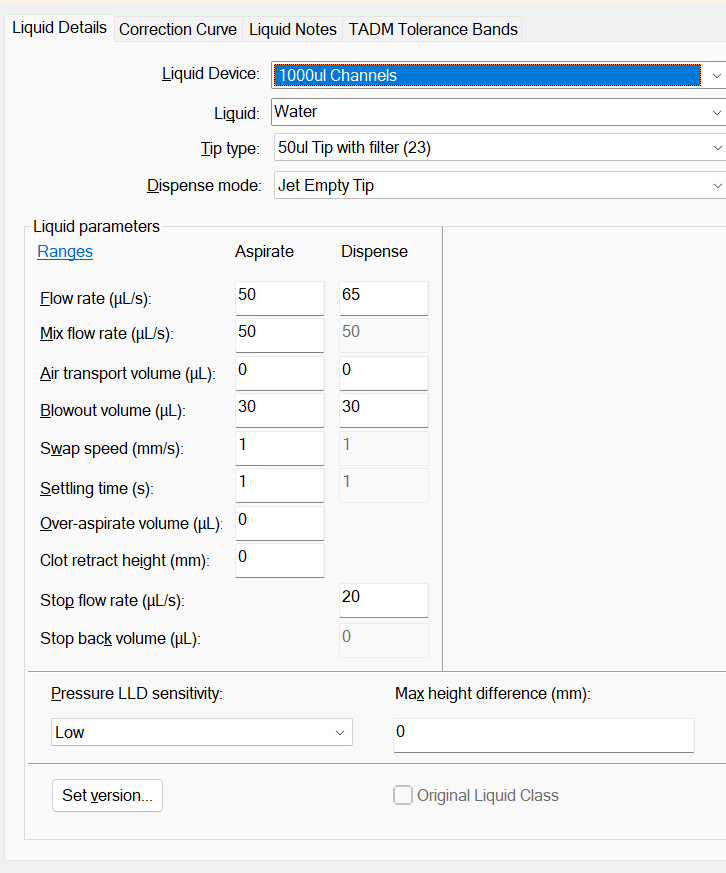
Third, you need to jet dispense 3ul onto a flat surface. You can purchase 50ul clear tips from Hamilton that have helped me immensely when trying to dispense very small volumes into dry wells. Add a dye to your liquid and really dial in the liquid class, this will be the toughest part. The below liquid class works for me when dispensing 5ul of diluted extracted DNA into an empty flat 1/2 area well but you would likely have to play around with it depending on the viscosity of your cells. Over-aspirate works quite well for small volumes (I don’t seem to have it in this liquid class for some reason).
Fourth, when dispensing, make sure to “touch off”. You can try 0.5mm and go down to 0.2mm if you need to without liquid following. Make sure to use a new pipette tip for each dispense.
Hi Christina,
Our of curiosity: why not come close to the slide and use surface dispense?
Also, instead of creating the whole labware, I would virtually place 384 plate on the carrier. That would virtually give me all the positions I need on that carrier to dispense. Then, I would use the teaching needle to get the exact Z I need for the slide.
I would hence virtually move the Z of my 384 on my layout so it matches the Z I defined using the probe.
I do think that you could lose some ability to do automated sequence handling for a virtual 384-well plate since the pattern of the slide spots wouldn’t allow for a universal virtual wells/spot. You might have to hard code the sequence increments or not use loops at all.
For a simple enough use case or for initial feasibility testing, it might be simpler to go through with that approach rather than defining the labware, although labware definition really only has to be done once
I agree with @YahyaB you would loose a lot of sequence handling functionality that you may have to continually error handle your way through. Given that it would take about 10 minutes and a set of calipers to make a new labware definition with the correct coordinates and sequence, it doesn’t seem like a good tradeoff.
You could try surface dispense and see if it worked for you. I came up with this liquid class based on a lot of the guidance written in past Hamilton PP presentations for low volume dry plate pipetting; and also Hamilton’s liquid handling guide. For me it worked on the first try and works consistently, but there may be better liquid class parameters for more viscous samples and different labs.
With 3ul of sample you need the bead of liquid to cleanly emerge from the tip, stick to the plate and release from the tip quite fast. With surface dispense (LLD off) you gain the functionality over Jet dispense to program in a swap speed and settling time, but since you want the tip to release the liquid bead quickly, they don’t add too much functionality. Still, it’s worth trying to move to surface dispense and playing with these settings if viscosity is causing a lot of issues.
 You can purchase 50ul clear tips from Hamilton that have helped me immensely when trying to dispense very small volumes into dry wells. Add a dye to your liquid and really dial in the liquid class, this will be the toughest part. The below liquid class works for me when dispensing 5ul of diluted extracted DNA into an empty flat 1/2 area well but you would likely have to play around with it depending on the viscosity of your cells. Over-aspirate works quite well for small volumes (I don’t seem to have it in this liquid class for some reason).