I am having some troubles stamping BSA onto Stunner/Lunatic Plates from Unchained Labs. I have tried using the liquid classes/liquid correction curve provided by this automation forum but I am not getting too much luck filling the full plate. I am serially diluting BSA from 300 mg/mL row by row on a 96 well plate and have Hamilton STAR stamp the solution to the stunner plate. I am dispensing (jet empty tip) very close to the well bottom, but I am getting empty volume on random location. Only about 50 percent of the wells are filled. Any idea on where the problem could be?
It’s been a while since I’ve worked with Stunner plates, but if I remember correctly the sample volume for those plates is 2uL? If that’s the case, I think a jet empty dispense is going to be difficult to make robust. First thing I’d check is that your tips are actually aligned with all 96 microwells and you’re not just dispensing onto the surface of the plate.
If that looks good, you may have better luck using a surface dispense liquid class and reverse pipetting. For example, aspirate 3uL, dispense 2uL, allow a few seconds settling time for the microwells to “pull” the liquid in, then throw away the remaining ~1uL.
Tecan specific advice here, but it probably translates about the same.
Slight volume over-dispense - very slow dispense speed and likely 0 or 1 stop flow rate. Try to create a hanging droplet then slowly lower it down or side-touch to start the capillary action without forcing the liquid thru the chip with the plunger.
Thanks both for your input! It seems like I made quite a bit of progress getting the right volume into the plate, but I am getting this error once in a while. Sometimes it doesn’t appear at all, but sometimes it’s on quite a few wells. I know the volume is delivered from the absorbance spectra but the result say I have a pump error code 1. I am following the part volume surface dispense mode and touching off as the second dispense.
That result with the pump error means that the sample itself has too high absorbance for the system to measure. Stunner plates and High Lunatic plates max out at 275 OD at 280 nm. Is it possible your sample is absorbing more than that?
I wanted to share my experience and advice on stamping to stunner plates here. There are a few issues that plagued me when developing my module for stunner stamping with the MPH, and the ultimate final form really surprised me. To start, some facts about the stunner plate:
The wells are tiny! Your labware must be taught well, and tip splay can be a problem. I found any time that tips hit the top lip of wells due to tip splay, that well would not read successfully.
Volume accuracy really isn’t that important – the only thing that really matters for the stunner plate is that you don’t flood the chambers in the capillary. If you put 1.5uL or even up to 4uL into a well, it’ll be fine. The capillaries are designed to favor liquid bubbling out of the well orifice over entering the measurement chamber as well, so you don’t need to stress liquid class precision much here
Liquid-to-tip adherence is a huge problem – if liquid decides it would rather stick to the outside of your tips than enter the capillary, you will get no value on your read for that well.
So, the solution that I implemented:
Use the MPH to teach to the bottom and pin the plate (as opposed to normal teaching that we do where we leave the smallest wiggle possible)
overaspirate and pre-dispense some liquid back into your source plate
dispense 2.5-3uL at a height of 0mm – this will lead to a small sound, the kind of sound that sends shivers through the spines of automation engineers, the kind of sound that says you may be crashing into the plate. Don’t worry, it’s worth it to get the liquid leaving your tip as close to the capillary orifice as possible, and the stunner plates are tougher than they look. I found diminishing results as I raised the height to anything above 0mm in my testing.
Use 300uL tips – I know, sounds crazy. But I found that when compared to 50uL and 10uL tips, the 300 tips have much less noticeable splay, and the wider orifice/tip body heavily prevents liquid from sticking to the outside of the tip rather than entering the well. With the thin 50 and 10uL tips, liquid regularly stuck to the sides of the tips for me. Using 300 means you need to teach these plates really well in the x and y.
After your initial dispense, move the tips back down to 0.3mm above the well bottom and use a series of x and y moves to press the tips against the sides of the well (~0.5mm from center of well to side of well). This will help wick any liquid off of the tips and will also encourage some motion in the liquid in the well, which will help it enter the capillary
Dispense any remaining volume back to source
I used a typical water LC for this, didn’t need to do anything special to get volume delivered.
I got it working some time ago, but thank you nevertheless! I had very similar experience in optimizing this workflow! You have some interesting idea that I want to try now.
@Automashe Thank you for sharing this, I’m curious to try this out as well. I’m currently using channels to dispense into Lunatic plates, and not dispensing at the bottom. Did you adjust your aspirate/dispense flow rates at all, and did you adjust your settling time in dispensing? Thanks again!
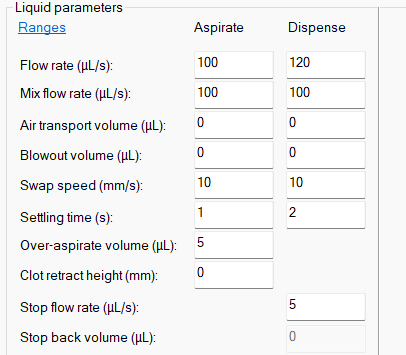
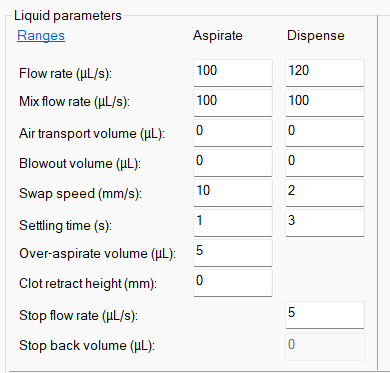
Hi Thetoly, here are the LCs I use for 300F tips. I use one for the predispense and one for dispense, the differences are minimal (settling time and swap speed) and I don’t really even know if the difference is necessary:
Some advice I’ve seen from the vendor and other engineers is to slow the flat rate down to something very low on dispense in order to get the liquid to form droplets rather than truly dispense. When I tested this at higher heights and observed, I found that on the MPH that the channels would form droplets on a gradient – one side would form good droplets but as you proceeded to the right along the channels the droplets got smaller and smaller. Overall it just wasn’t equal, so I resolved to solve this problem with a flow rate that would result in liquid dispensing from all channels on the head. This would likely be less of a problem with channels.