I’ve been finding posts in this forum insightful and decided to create a profile to ask this question.
I work in a PCR lab that adopts risk averse procedures in terms of potential for contamination events while using liquid handling robotics (Hamilton STAR and others). Potential for contamination with general robotics use has never been thoroughly tested or disproved, so the risk is assumed to be true.
I wanted to ask for thoughts/suggestions on experimental design to disprove the risk and allow us to streamline some workflows.
I don’t want to use one of our assays, or anything that could be reactive with our assays, due to potential consequences if a contamination event did occur.
Fill whole plate with wells >50% full, checkerboard pattern of known positives, measure all wells after shaking, pipetting, etc. qRT PCR would be a great asset for identifying well cross-talk.
PCR specific, you could set up PCR in open air vs flow hood to gauge background for your lab environment. If it’s really dirty, your NTCs could be as high as 30 cT, so it’s good to understand the baseline before diving into what is or isn’t causing contamination.
Measure current risk, predict potential risk improvement of automation, then measure actual risk after deployment of automated workflow. Use these three metrics to drive confidence by ensuring that potential is about equivalent to actual (e.g., not sandbagging), and that actual is always better than current (e.g. impactful). If these two statements aren’t true, the automation is not worth developing or using.
I probably should have been more descriptive about our current setup:
-We already use automation
-We segregate various automated workflows (inefficient) due to perceived risk
-Our work is clinical diagnostics, so risk from automation has to be 0 (unless it can be identified prior to amplification)
I was initially considering whether something involving black light or colour change paper would be a good idea, but on further thought, I think this would never be sensitive enough.
I’m now considering whether it would be worthwhile to develop my own synthetic PCR assay to run a test like this.
Liquid transfer, from known highly concentrated source material, is isolated away from more efficient robotics (that get used for all other liquid handling) and instead only processed using older robotics.
Specimen transfers, from sample types that infer strong clinical response from detected PCR results, are completely isolated into workflows separated from other sample types. Specimen liquid transfer occurs as an individual step prior to extraction/purification and then inoculation/reaction.
I’ve also used checkerboard testing substantially to assess instrument performance, independently from contracted engineers.
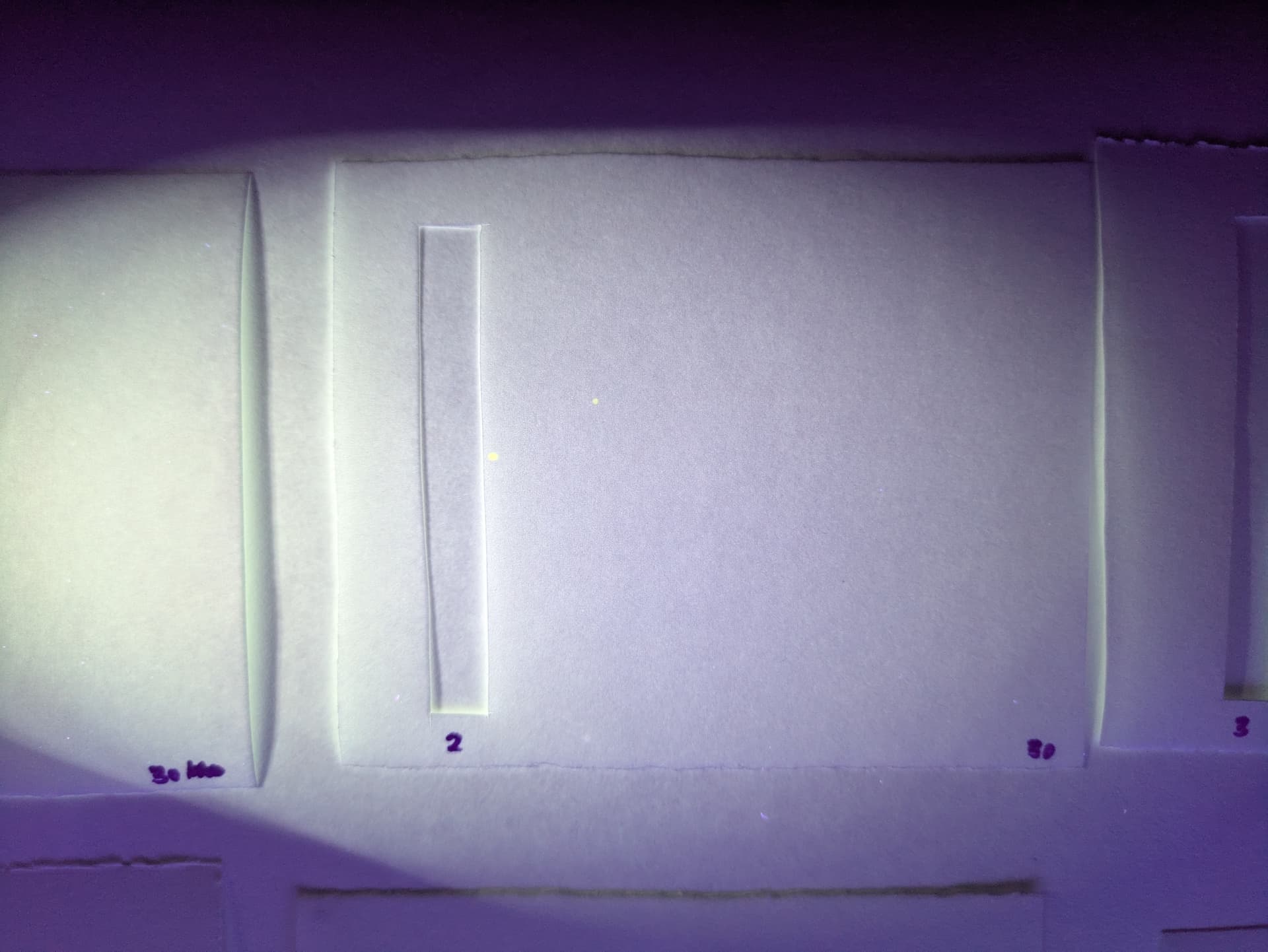
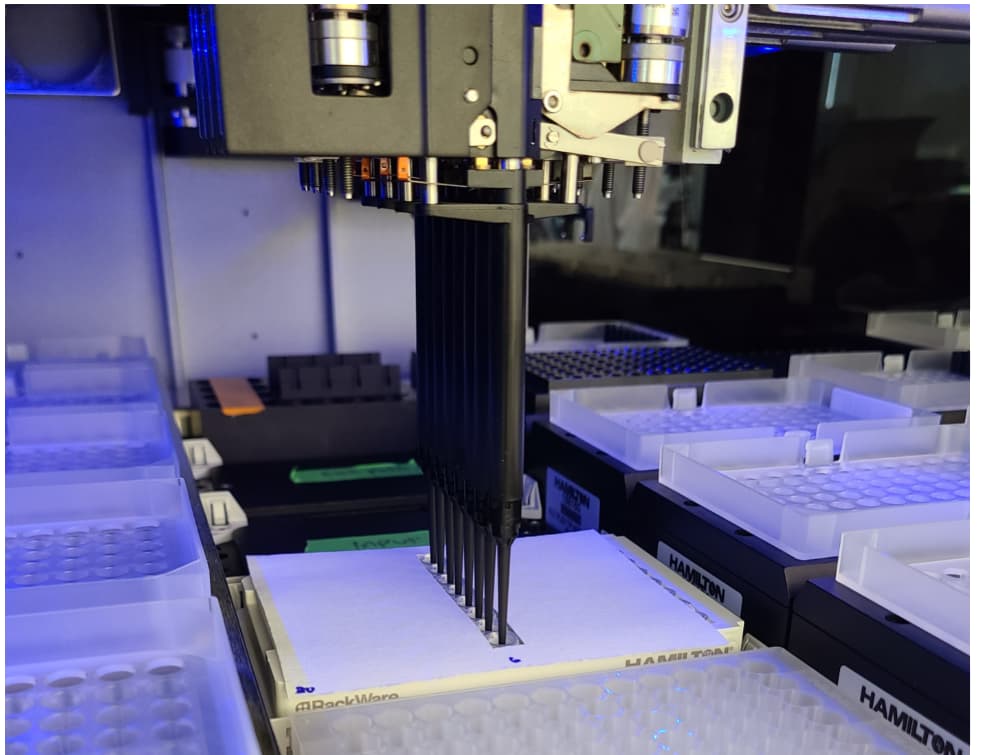
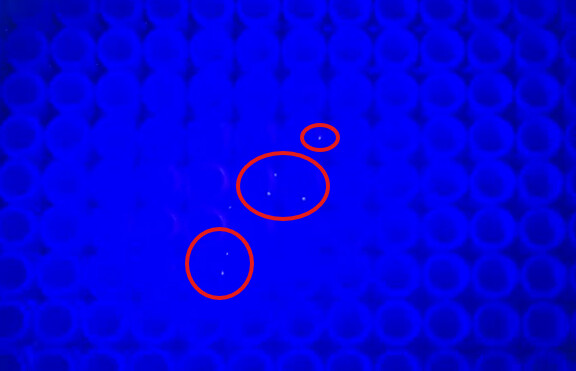
I work with a similar tolerance for contamination in a DNA lab. We do checkerboard full plate - high concentration sample interspersed with negative controls (at least 3 full runs each time something is changed - many many more if this is a new procedure or instrument being brought into the lab). This is taken through amplification and DNA typing (quantification, qPCR, can miss very small levels of contamination as it is often below the level of detection). We have also used fluorescene dye, visualizing at each step (see photos). I’m not sure the latter is needed, if you dont ever have any contamination. But is very useful for identifying the step if you do find it. We followed this paper: https://www.sciencedirect.com/science/article/pii/S1872497324001534 ( Demonstration of potential DNA contamination introduced by laboratory consumables using Fluorescein)
If you want cheap, no contamination risk, but sensitive I recommend using a dye and a spectrometer, both of which a diagnostic lab is likely to have.
Mind you, nothing will be just running the thing you want to run on the machine with test samples. Because otherwise you get the problem of exagerated risk because you use a super sensitive method and find something that your diagnostic assay would never be able to detect.
I second the checkerboard method. Just make sure, that your positives are highly positive (similar to the highest titered sample you expect to have) and also ensure that your contamination doesn’t occur during manual steps prior to the automation. In our case we use positive samples between Ct 10 and 15. That gives us 25-30 cycles and thus an amplification of > 3x10E7.
You can never prove absence, however. So there is no guarantee. But you can assess the risk with the data, though.
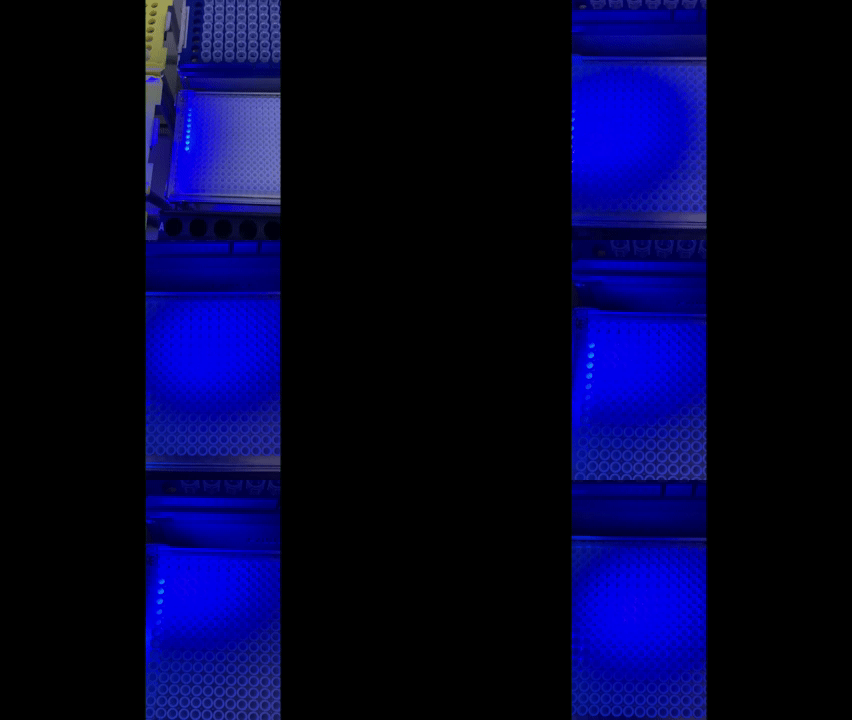
Also, fluorescent dyes were mentioned in another reply, this is a great method to identify risk that may not even lead to contamination all the time. We recently discovered a problematic setting in a liquid handler that was hardcoded in the background. You can see in the attached gif, that fine droplets were created due to this, that are visible on the surface of the 384-Well plate. This was eye-opening.
It was a hardcoded blow-out after sample dispense. This caused bubbles that burst and sprayed all over the plate. We turned that off and everything looked nice, so too in the subsequent qPCR.
Thanks everyone. I’m finding lots of the information provided here useful, including the journal article.
My lab is accountable to a regulatory body, that will assess based on ISO documents and other guidelines, but it doesn’t drive my verification needs (in this topic).
I have a pretty new spectrophotometer available, which sounds like a good option if I use the right setup. I’ve run heaps of light absorbance testing to verify volume transfer accuracy/ precision but not looked at context for contamination testing.
I do also like the option of fluorescent dye testing. I’m also now considering it as a means for training/improving understanding/respect for contamination risks with general laboratory practices.
We can get CTs as low as 1 or 2, depending on source material, although that’s not common to most of our testing. There’s established concern about some contamination events being potentially impossible/near impossible to clean, which is why I wouldn’t want to use one of our pre-existing assays.
We do develop many of our own PCR assays, so that option is available to me. I’m feeling like it might be best to run spectro and fluoro dyes (visual) though. I don’t view having excessive sensitivity as a bad thing, as long as I can account for it, it would provide additional insight.
Fluorescein, H2O, checkerboard pattern. Using a solution validated to x log scale depending on your needs. Testing one pipetting step at a time ideally.