Hello everyone,
Has anyone encountered this issue?
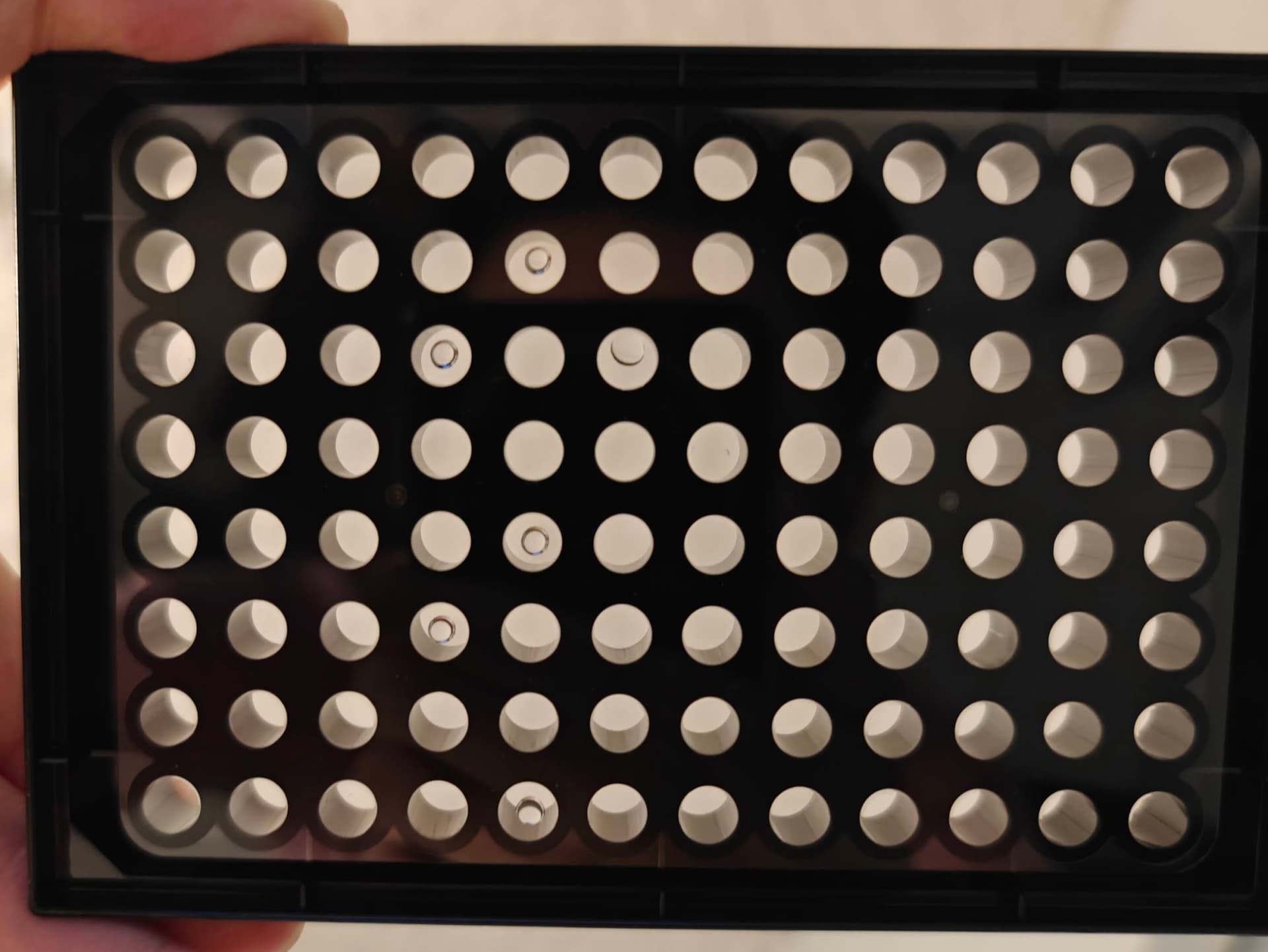
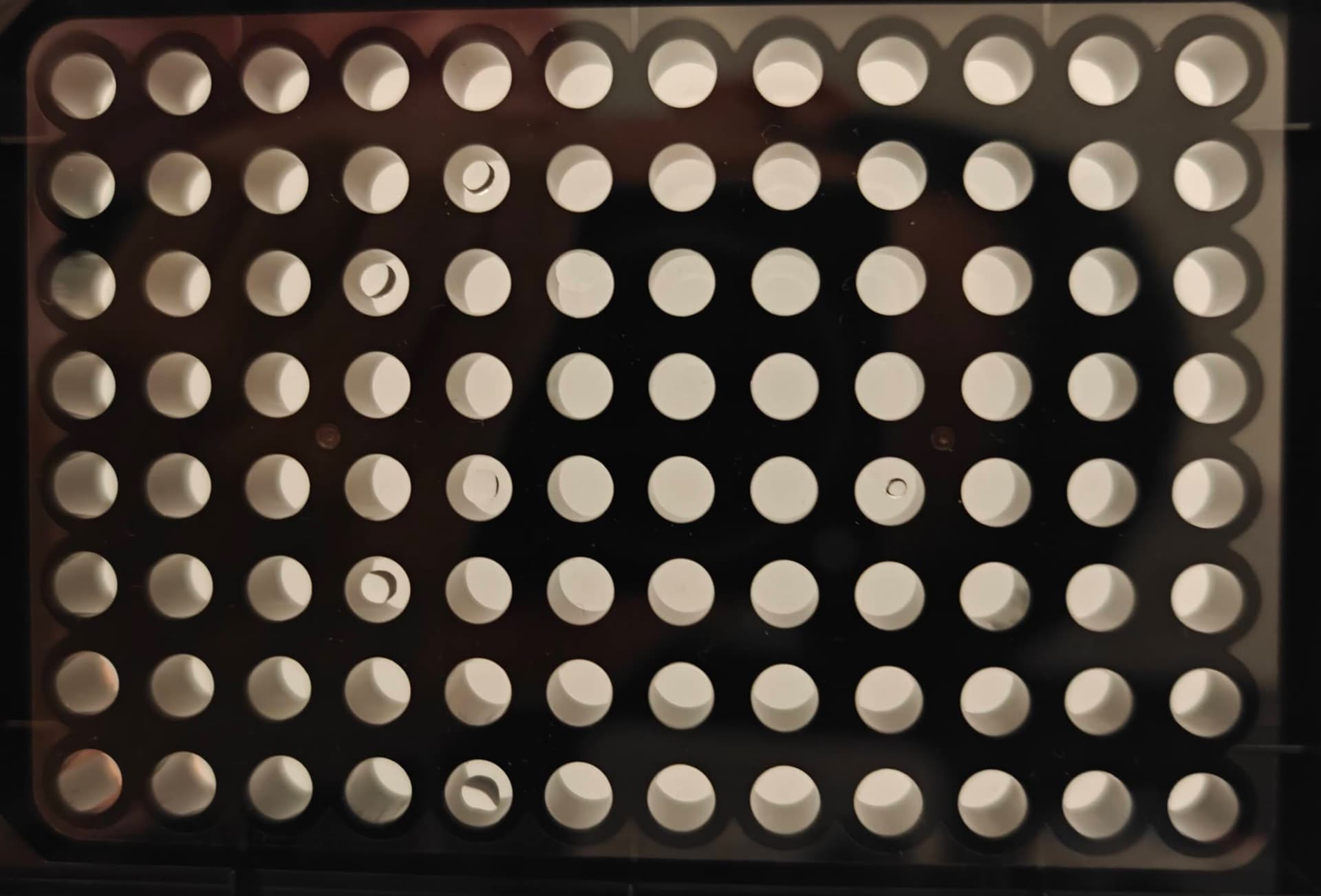
I’m trying to perform a “multi-dispense” by aspirating a bunch of solution, then dispensing 1 uL into each well of a 96 well plate. However, liquid is only coming out at every 3rd well, and it looks to be a larger amount than 1 uL!
I have tried:
Doing it with and without using configure_for_volume() to enter low volume pipetting mode
Using .distribute() vs manually doing .aspirate() and .dispense with a for loop
Checking that the code isn’t inadvertently dispensing every 3 wells
I’m guessing that the move is to adjust the push out volume or something, but how do we ensure that the pipette is accurately dispensing 1 uL, even if liquid is successfully deposited into each well?
Update: I tried manually adding a push out but got the error
“Error 4004: CommandPreconditionViolated
Cannot push_out on a dispense that does not leave the pipette empty”.
So maybe I’m not getting liquid into each well because a multi-dispense doesn’t do push out at all? (Which makes sense tbh)
Update 2: I also tried raising the flow rate to rate=3 (i.e 3x the default flow rate) in hopes that it would be more forceful and successfully push the 1 uL volumes out, but the result appears to be the same (>1 uL coming out every 3-4 wells).
Thinking out loud: What to do!? I’m looking to add a different additive to my 96 well plate, where every 4 wells is a technical replicate. I suppose I could separately mix up 24 batches of culture media + additive then add to the wells once mixed together. This would allow me to work with larger volumes
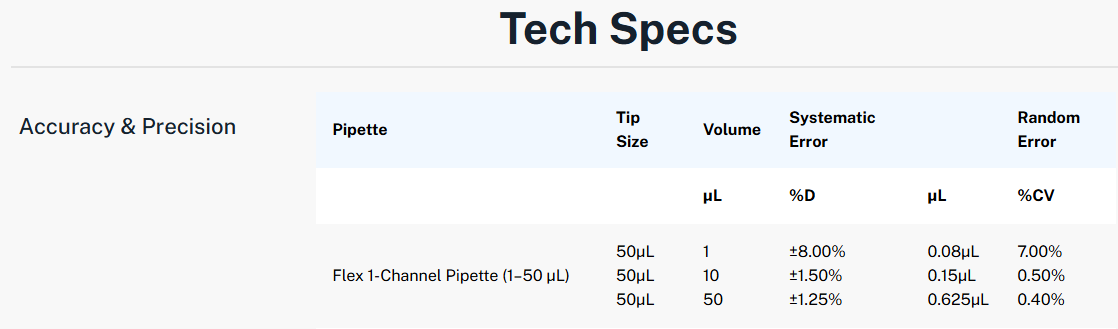
I think you are better off working with larger volumes. 1 µL is the lower limit of the pipette you are using (I am assuming you are using the 1-50 µL single channel pipette, correct me if I’m wrong) so you will always have worse accuracy/precision percentage-wise for your 1 µL:
What sort of additive are you adding? The liquid properties of the additive could prevent a 1µL droplet from being dispensed (viscosity, surface tension, etc) and only after multiple pipette dispenses is the droplet large enough to drop from the pipette tips. Depending on your intended plate layout and your OT configuration (8 channels available?) You might be able to prepare your 24 batches in a separate deep-well plate and dispense the larger volume replicates using 8 channels and have the replicates in groups of 4 columns
Yeah, maybe it’s better for me to lean towards the higher volumes :s
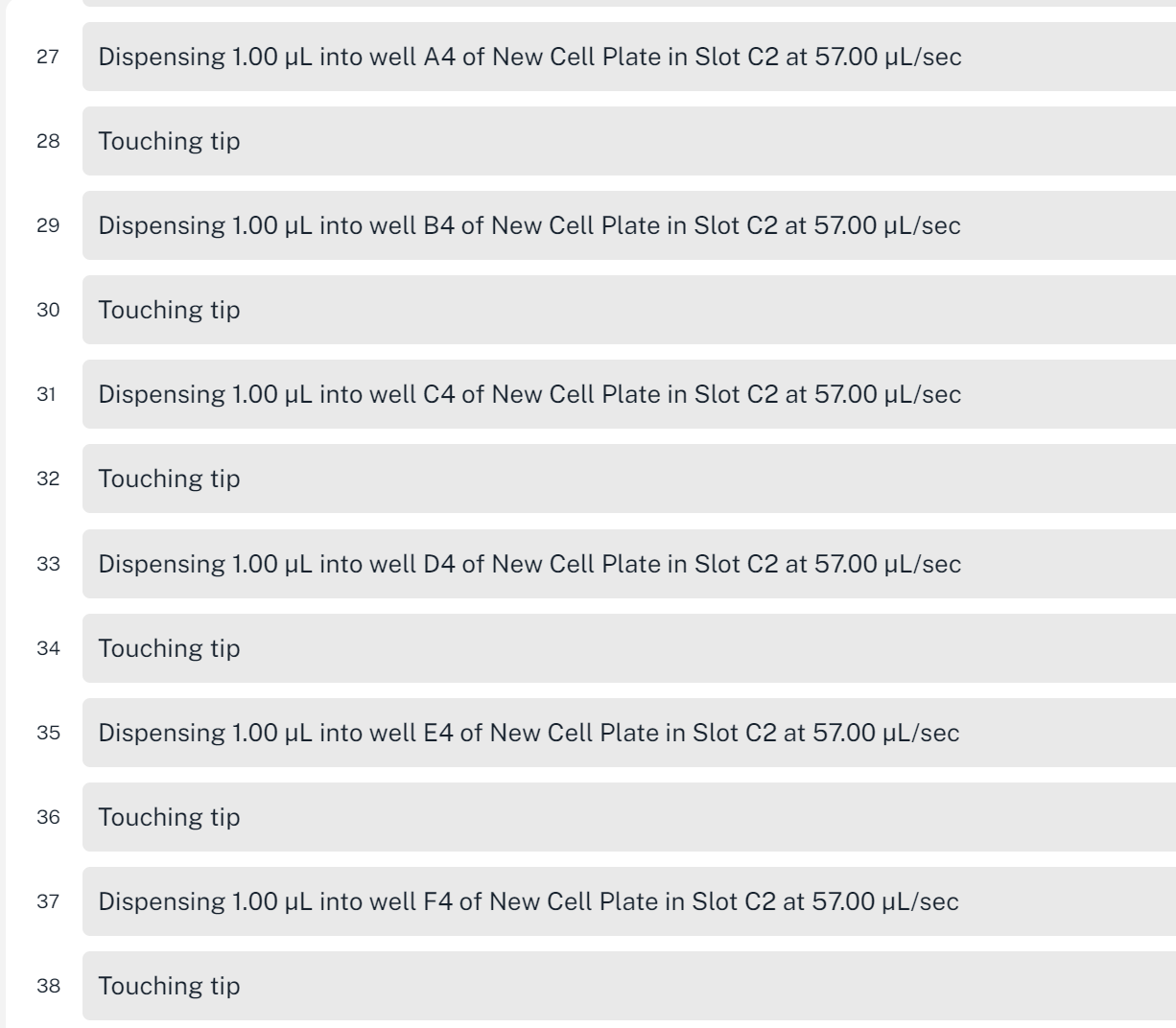
I’m adding a protein dissolved water/saline, it’s material characteristics are pretty much like water/saline, it isn’t viscous etc! I’m doing touch tip in case the droplet gets stuck on the tip, but it seems like no droplet comes out until every 3-4 dispenses. I’m guessing the dispensing force can’t overcome the surface tension until 3-4 uL of dispensing air pressure, after which it releases the whole 3-4 uL of liquid. (Note for the pics above it’s just water, from my water-only run!)
I currently have a 96 deep well plate on my deck configuration where I use 3 columns per run, so I think I’ll use 3 more for my 24 batches and use 6 columns per run :o
Maybe this ends up more precise than before since the protocol will be working with higher volumes, silver lining…
I do not have experience with Flex, only with Agilent Bravo, but I think you should try the opposite of what you tried and slow the pipetting down. With 57ul/s speed shown in the log, the machine tries to dispense during 1/57 s. I always have better results with small volumes when pipetting slowly.
Also, Im not sure at what height above the bottom you are dispensing, but I would try low ( 0.1 or 0.2mm) above the well bottom to let the drop catch the bottom insted of just hanging from the tip.
Ooh thank you, I’ll try slowing it down! I am currently doing 1 mm from the bottom with touch tip turned on. I was scared of colliding with the plate if I went closer than 1 mm, but perhaps that concern is unfounded!
1 uL on dry dispense is tricky with a multi dispense. I think you’re on the correct path of slowing down the dispenses as well as suggesting working with a higher volume if you are wanting to do multidispensing. I would be comfortable saying we could support a 4-5 uL per dry multidispense, BUT the hard part is always getting the first and the last dispense dialed in (first will have less, last dispense will have more). To compensate for this, you could add a dispense factor to compensate for these differences in python. This would take some fine tuning.
Also, it was great to meet you in person yesterday!
For now, I think I’ll just try to avoid the small volume dry multi-dispenses haha - should help with experiment reproducibility too if there’s less variance in the pipetted amounts! Thankfully in my protocol I have extra deck/well plate space to premix larger amounts of cell culture media for my n=4 groups (instead of mixing each well’s media/media additives in the individual wells)
Tried a new experiment where I was making a bunch of cell culture media containing different combinations of additives, where I’d add 2.5 uL of additive to the media with configure_for_volume() set to 2.5.
This time, I was pipetting into the liquid instead of doing a dry dispense, but unfortunately it still didn’t work. Liquid would only come out every few wells
I tried slowing down the flow_rate to 1.25, and it helped partially, but sometimes the liquid would come out delayed (i.e as the pipette is on its way to its next dispense location). It also appears to pipette out excess volume or something. (My multi-dispense ran out of liquid before the final well destinations)
Ultimately, I changed the protocol to have 5 uL be the smallest multi-dispense volume, and it appears to be working fine at that vol!