Just wondering if anyone has experience with pipetting pH=14 solutions ( let’s say 300 uL) with 1000 uL channels?
How about pH = 3?
Does this damage the channels?
Are the tips tolerating this?
If you use a filter: does the filter absorb all the fume/protect the inside of the Channel?
Hi there,
we did try to pipette bleach to sterilize tips inbetween samples (pH 11) however it did start to cause corrosion on the metal parts of the probe head. Would not recommend
best
Dominik
Our tips are manufactured with 100% Medical Grade Polypropylene and thus since this material is used to store many organic and inorganic solvents at room temperature in a general lab setting, the tips in most cases should be fine. It is oxidizing acids and bases that will be an issue.
And then you have to consider both the internal components of the channels as well as the system in general in cases of spills or working with acids and bases that have strong vapor pressures (especially if they are heated).
If you have access to the VENUS operator’s manual there is a chemical compatibility section in the appendix that has all of the information you need.
Was that because of the pH or because of the chlorine? I bet the oxidizing agent is what caused the oxidation.
Just from a chemist POV, I think it really matters what acid or base you are talking about. Even with the same pH, two different acids will have very different chemical properties.
Unless you describe what type of acid or base you are talking about you’re just going to be comparing apples to oranges with the responses you get.
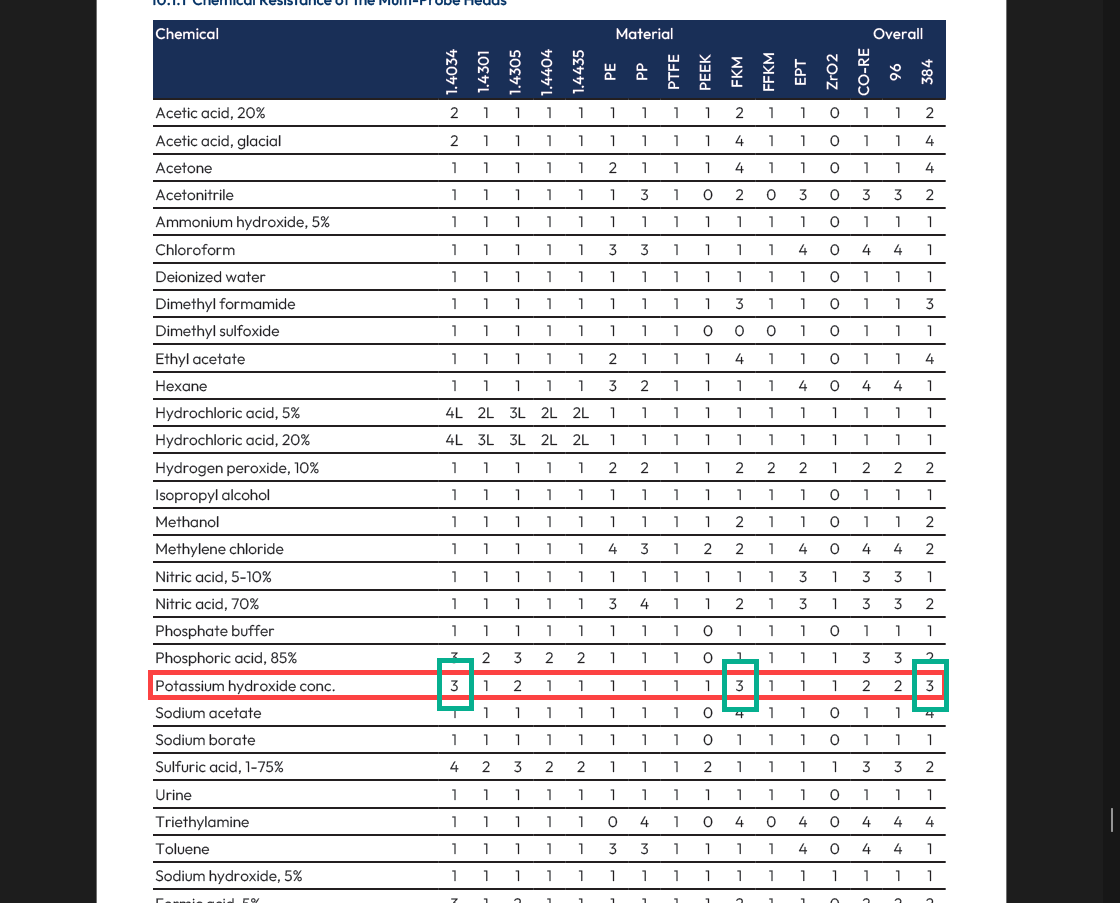
Ranked by following the guide below, concentrated KOH has values of 1 to 3 with 3’s on viton, the MPH384, and a type of steel that is not listed as part of the CO-RE channel interface.
1: No effect, little or no noticeable change
2: Slight corrosion or discoloration
3: Moderate corrosion or other change in physical properties or dimensions, not recommended for continuous contact
4: Severe corrosion or physical change, prolonged contact not recommended
I have taken a look at the operator’s manual and still have questions regarding the table, more specifically the 1L-4L values listed for hydrochloride acid.
You see, my lab plans to work with 1-2% HCl in the near future, and while the overall value is 1 for CO-RE, 96-head, and 384-head, I am uncertain on what the 1-4L values mean in a boarder context. It says that “L” stands for danger of pitting/localized corrosion (creation of small holes in the metal), but can this be negated with frequent PM and replacement parts of the stop-disk, o-rings, and washer of the pipetting head, for example?
We have many customers who use our liquid handlers with a wide range of reagents, including strong acids and bases, as these are often necessary for clinical, forensic, and analytical workflows.
Dilute hydrochloric acid in the 1–2% range is commonly used on liquid handling systems when handled appropriately and as part of normal operation. As with any corrosive reagent, standard laboratory precautions are important. Adequate ventilation is especially helpful, since acidic vapors—not just liquid contact—can contribute to long-term wear. Some labs address this by tying the instrument enclosure or deck area into their room exhaust.
When working with corrosive reagents, filtered tips are recommended, and some users choose to program gantry movements to avoid prolonged positioning over open reagent reservoirs during idle or incubation periods.
The primary risk to the instrument comes from spills or prolonged surface contact that are not cleaned promptly. While many metal components are protected by black anodizing, direct exposure to strong acids or bases can compromise that coating, which may then lead to corrosion of the underlying material. Following your lab’s established spill-response procedures and routinely wiping down exposed surfaces will go a long way toward keeping the system in good condition. Regular preventive maintenance and PMs will also help catch any early signs of wear.
I hope this helps as you evaluate your workflow, and we’re always happy to discuss best practices others have adopted in similar applications.