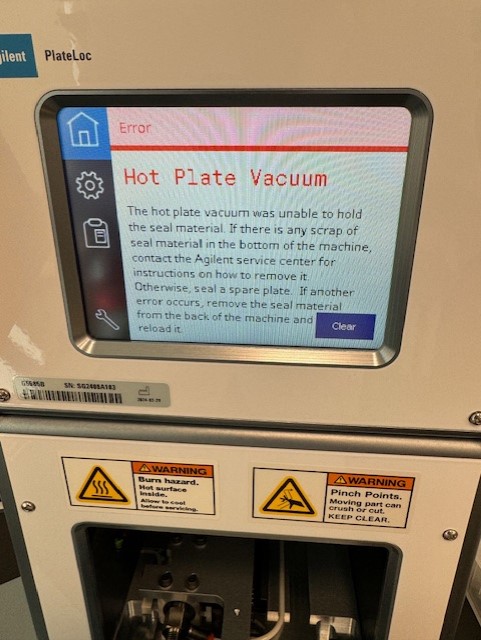
We just bought two brand new PlateLocs because of their reputation and hardiness but our initial experience has not been great. After waking up from sleep mode, we consistently get a “Hot Plate Vacuum” errors and have to fish the sealing media out with forceps.
Has anybody experienced this and come up with a reliable resolution?
While I have come across this issue a few times before, the fix here described on the display and in the manual on page 99 (chrome-extension://efaidnbmnnnibpcajpcglclefindmkaj/https://www.agilent.com/cs/library/usermanuals/public/G5402-90001D_PlateLocUG_P_EN.pdf) fixed it for me every time.
Have you contacted Agilent service yet? They’re pretty quick depending on region.
Just as a data point we don’t let ours sit for more than 24hrs of inactivity. Or if we do then we’ll run a test plate through it and expect to have to correct an error. It’s really only Monday morning that we usually have problems if we didn’t have anything running over the weekend.
In my opinion, as long as you keep the hot plate clean there is not a more reliable heat sealer than a PlateLoc.
@Brad It could be due to the cutter blade being out of alignment. Does the Plateloc cut the foil and not stick to the hotplate? or does it not get that far?
You could try playing with the tuning/timings. I’ve had to do this in the past. There is a return to defaults if you are worried you went too far.
I also second cleaning the hot plate if you haven’t yet.
Another cause can be something sticky in the transfer plate that tugs on the seal preventing it from holding nicely to the hot plate vac ports.
Pro tip: Don’t let the seal reel run out, then draw into the plateloc, the piece of tape at the end of the seal spool that holds it to the reel. That piece of tape will drive you insane and depending on how sticky it is, it will require a complete disassembly of the plateloc to remove it. Moral of the story, don’t get anything sticky into the plateloc.
2nd Pro tip: When threading through new seal and cycling the plateloc to test it, use an already sealed plate. This will prevent the plastic of the plate from melting to the hot plate in the event that the seal does not actuate through.
Source: Near decade of xp in a lab with 40 of these things.
This is quite an old post, but I thought I will add a reply for anyone googling the issue and running into this thread.
This issue is unfortunately quite common with new Platelocs, especially with the clear foil which has lower tolerance for high temperatures.
What happens is that the front edge of the foil, which is quite close to the hotplate, gets melted slightly and either sticks to something inside or curls, both resulting in error when trying to pull the foil.
From user perspective, what you can do is to cool down the Plateloc after the last seal, and if you can do one more lowtemp seal to cut off the potentially curling foil, that should remove the issue completely. Aluminium foil should be fine up to 160°C, clear foil up to 110-120°C.
Alternatively, technician can come and tune the machine, so that the foil doesnt protrude so much forward, and also increasing time of step 6 in the service settings helps. I would call technician if your system is under warranty and you are not using higher temperatures than recommended (than its user fault oc).
Because you mentioned that this is more of a thing with newer instruments. I had someone suggest me not getting a Plateloc with color display but an older one instead. Do you agree on this one? Also has this problem been fixed?
I found 160 °C quite low. When I tried to get a proper seal on some Echo plates I was more looking towards 175 °C. It was the aluminum seal (non RT though, so white top). Would this cause problems for the instrument or are people really getting a good seal with 160 °C and 1.2 s or so? I also was ooking at 2.5 seconds or so instead..
I think the new Platelocs are fine. There was new firmware release that got rid of some annoying bugs. The hardware is basically the same, apart from the screen. It is true, that they maybe dont arrive completely well-tuned, but I think you should be able to have it tuned during install and subsequent warranty. Also, I think the new screen is more user friendly, there is handy optional sleep mode etc.
Regarding my previous comment on the temperatures - you can definitely use higher temperatures if you find the seals better that way. Just note that if you let the instrument stand with a high temperature for longer time, some melting can occur. But this applies more to the PCR foil than the aluminum one. I found cooling the instrument and doing one low-temp seal prevented issues on the next use.
Finding the correct temp/time settings is mostly something you have to test for you specific plates. Overall, higher temperatures and shorter time seems to work better to me, because less heat is transferred into the plate. But some plates are just difficult, typically the Echo plates, which are not flat so they tend to not seal equally.