I’m running an older EVO with the Te-Chrome attachment and am having trouble with wildly inconsistent volumes being collected in the microplate. In my scripts I’ve been targeting 300ul per well, but as the run progresses the average well volume can reach <100ul, and the odd thing is that when the collection plate is switched out for a fresh plate the collected volumes will bounce back up to closer to target.
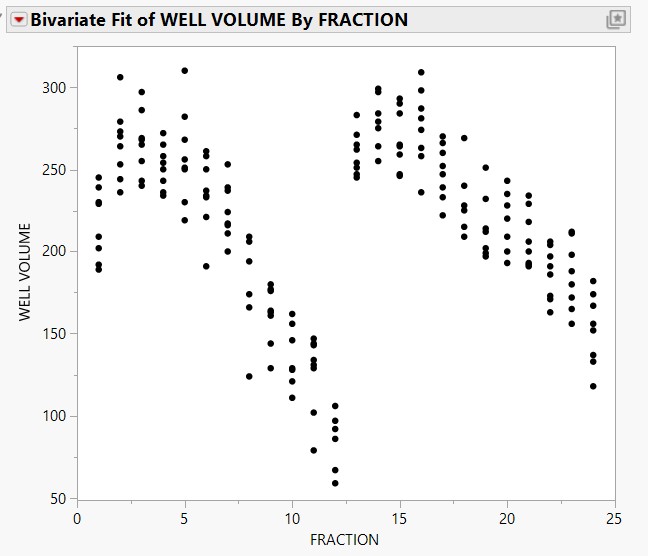
The columns are 600ul, the plate is a UV/VIS 350ul plate. Volumes determined via A975/A900 measurements. Graph enclosed shows collection volumes across two plates, each column on the plate being 1-12 on the first plate and 13-24 on the second. All rows (A-H) are graphed as a group per column. There is a tip wash command before each aspiration command.
this looks like an issue with the system performance at the target flow rates, with the specific resin with the material being loaded
i would say the issue is kind of typical with the Tecan platform, but you are seeing extremes here,
we have integrated flow sensors & pressure sensors to track the flow behaviour for a given column/given pipette channel to identify scenarios like the above - to yield some empirical data to troubleshoot after the run is completed
can you provide more details on resin, flow rates, titer concentration ?
This is mAb Select Sure LX (85um beads), this was a blank run with water (I see similar performance with protein), flow rate is 2.2 ul/sec, there is a 4 second delay after dispense in the columns before the needles are retracted to working height.
I don’t see fluid bypassing the column seals on the top or missing the wells by wicking somewhere it shouldn’t be.
These are lightly used columns (<10 cycles).
There’s a lot here I can’t wrap my head around, but the fact it has a “step correction” between plates is just wild.
EDIT: Turns out that I can’t just remove the columns from the equation. The height at which the tips drop liquid causes splashing/inconsistent landing in the wells.
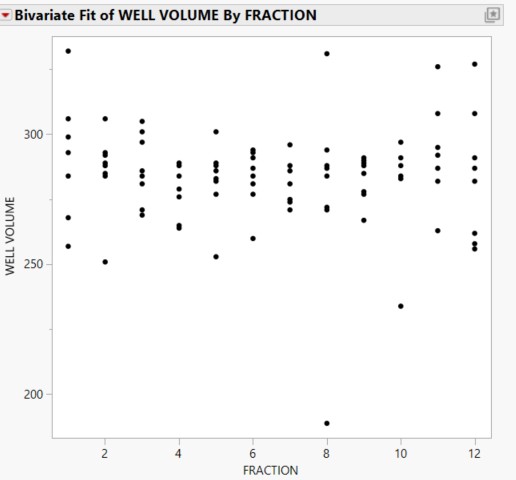
Alright moved the target plate to the deck and used the same liquid class to fill a plate. The consistency is really bad but it doesn’t have that continuous drop that it did going through the columns.
Both these graphs show the volumes dispensed by all 8 channels in each column on the plate, so “Fraction 1” is the first column, A1-H1 and that continues on to A12-H12.
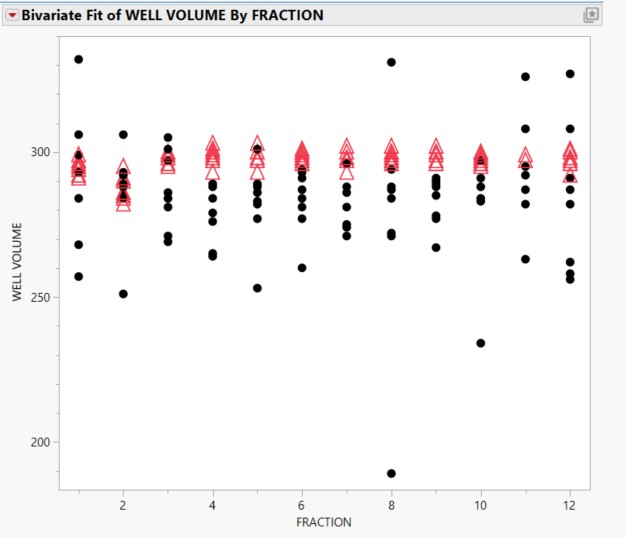
The 2.2ul/sec dispense rate is really noisy. I redid the run but used water free dispense and got better (but not great) results, so it looks like I have a combination of factors working against me. I’ll likely have to redisign how I do these experiments to account for the significant variability and innacuracy that seem inherent to this platform.
The new graph shows the 2.2ul/s data in black dots and the new “water free dispense” data in red triangles.
I have the ~1mL syringes on this unit (I don’t recall exactly).
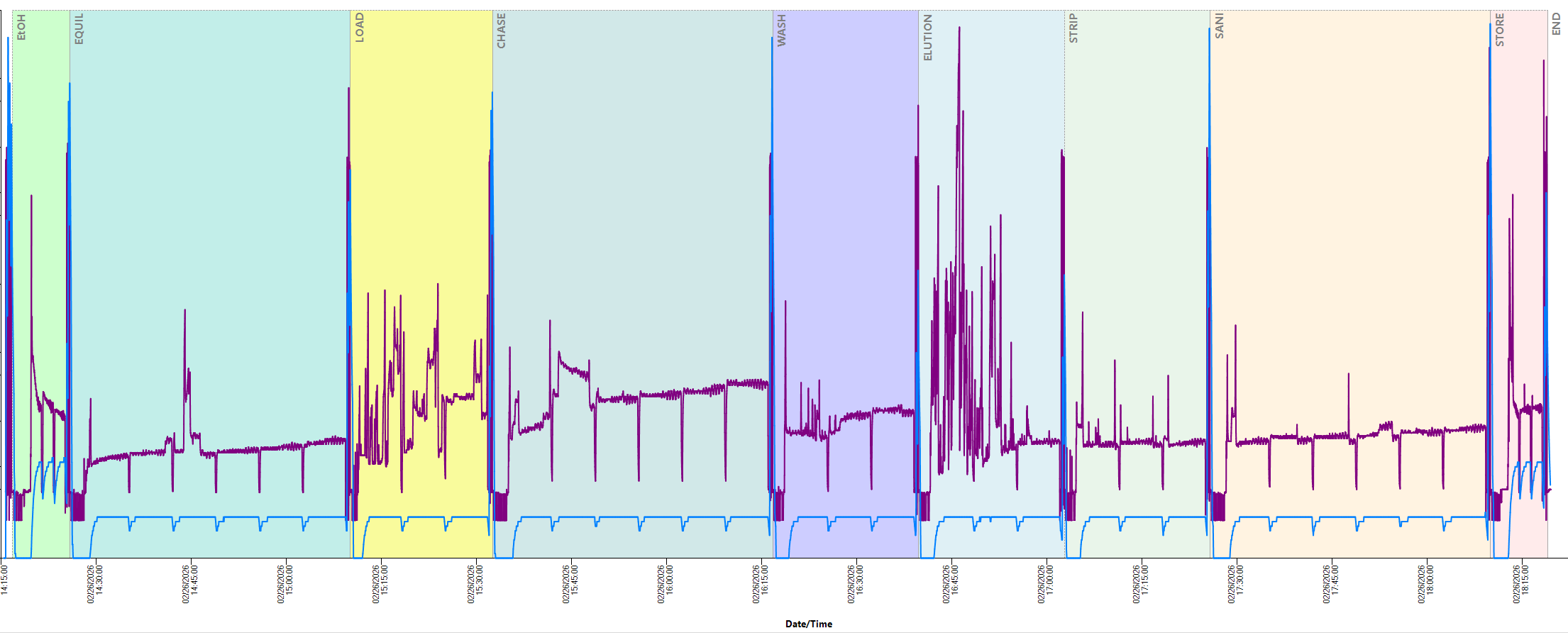
we are also generating real time data to allow visualizations of the situations that you are seeing - back pressure & flow monitoring of the syringe pumps dispensing across the columns to allow you to assess unusual behaviour per column/per pipette channel over the duration of each phase/each run,
we offer PM services specifically aligned to the Robocolumn application - monitor flow rates, larger volume dispensation checks - in addition to typical liquid system parts
a lot of our clients have been frustrated with the typical manufacturer testing for dispense volumes at 10 uL & 100 uL ONLY - where HTPD is more interested in dispensation at 150 uL/min over a larger dispensation of 12 mL (20 x CV at 600 uL)
What’s you flushing scheme look like prior to doing a run? Do you hear a lot of air getting flushed through the system when you do it? This looks like you have a problem with air intrusion, even a tiny bit can cause massive fluctuations in dispense consistency.
Part of regular maintenance (weekly at least) should include checking the tightness (just finger tight) of all connections on the syringes, and less frequently the other connections on top of the system at (I forget the formal name) the distribution block where it splits one tube into 8.