Hi everyone,
I am excited to announce the release of VerisFlow v0.4, another step towards making AI a practical tool for generating HSL methods.
The journey with VerisFlow has been focused on steady, practical progress:
- v0.2 proved that AI could generate HSL methods capable of running in simulation without errors.
- v0.3 explored how to control the AI to produce these methods consistently, not just randomly.
Now, VerisFlow v0.4 verifies a crucial element for real-world use: setting precise pipetting parameters directly from a natural language prompt. This includes multi-channel volumes, tip types, liquid level detection, mixing cycles, and fixed/retract heights.
Key Features in VerisFlow v0.4:
- Direct Worklist-to-Method Generation: Simply attach a worklist file, and VerisFlow automatically generates the corresponding HSL pipetting protocol.
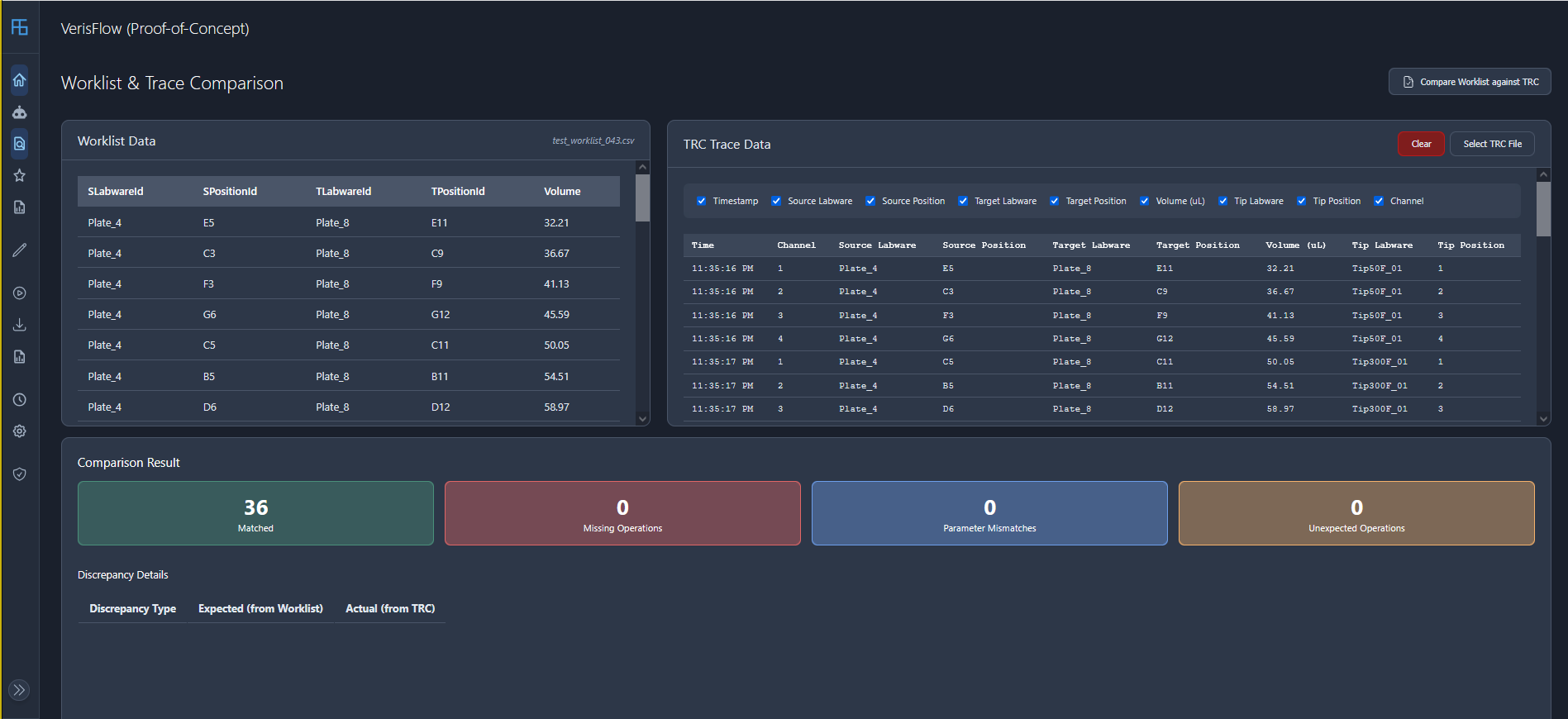
- Automated Verification: VerisFlow can now extract data from a trace log (.trc) and verify it against the original worklist to confirm accuracy.
- Dramatically Enhanced Reliability: Our latest tests show that by optimizing prompt engineering, we have boosted the success rate of HSL method generation from 65% to 92% .
See it in Action: Check out this short video demo to see how it works: https://youtu.be/WMOElF0OVPc
The testing involved generating HSL methods from 100 randomly created worklists. Each generated method was then run in simulation, and the resulting trace logs were programmatically analyzed and compared back to the initial worklist.
A Note on Performance: Based on our 200 tests, the average time to generate a successful method is about 166 seconds . This requires an average of 1.3 to 1.7 API calls, as occasional failures may necessitate a retry.
For a deep dive into our methodology, data, and a full breakdown of the results, please see the resources below:
- Full Test Report: VerisFlow
- Test Data on GitHub: GitHub - VerisFlow/verisflow-v0.4-hsl-generation-test-suite · GitHub
- Trace Data Extraction Tool: GitHub - VerisFlow/TraceLogicLocal · GitHub
Feel free to try VerisFlow at www.verisflow.com.
I’m looking forward to your feedback and hearing about your experiences.
Best regards,
Xianghua